Sunday, July 19, 2020

The Big One That Got Away

We had hooked a big one. A large halibut, maybe 80 pounds or more. The fishing rod seemed to almost bend in half while I leaned back and held on with both hands, the butt of the rod digging painfully into my waistline.

“Let it run. Let it run.” Shouted Keith, our fishing guide. I let go of the reel handle … too slowly.  It rapped my knuckles as if punishing me for holding back the catch that was swimming away for its life. After less than a minute or two the line went slack as if the fish was resting or hesitating, wondering which way to go to shake off the hook I hoped was buried in its mouth.

My legs and arms were already stiff. But I needed to reel the line onto the spool, taking advantage of the momentary indecision on the part of my quarry. I was constantly at the ready to release my grip on the reel handle if my prize catch decided to make a run for it again.

While it had only been a few minutes, I was exhausted. The Parkinson’s-induced stiffness resulted in my tremors moving into overdrive. I was worried I would lose the fish, while at the same time I wanted to prove I could land a trophy despite the limitations imposed on me by my Parkinson’s disease. But discretion won over my ego and I called for my friend, Jim, to take over the rod.

No sooner had the handoff taken place than the reel started spinning, the line whining off the spool as it played out, quickly approaching its limit of 300 feet. “That’s no halibut”, shouted Keith as he got his knife out to cut the line before the rod and reel were yanked from Jim’s grip and dragged into the ocean. We all felt the defeat as the knife sliced through the tense 80-pound test fishing line, leaving the lure and hook embedded as a souvenir in the mouth of the one that got away, whatever it was.
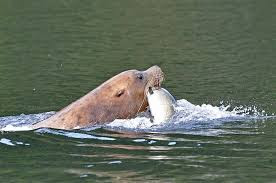
We all stared astern, looking rather woeful when Keith raised his arm.  He was pointing at a large black head that had popped to the ocean surface some 200 feet away. It was a sea lion. Doubtless, it had sunk its teeth into our trophy halibut, dragging “our lunch”, the hook and all the line we had, finishing it off outside the reach of our puny rod and reel.

While we resented losing the battle, we had to admit that we were the intruders, and that the natural hunter had made the catch. Acknowledging defeat is a humbling exercise, but it is, whether facing Parkinson’s disease or some other dominating opponent, one we must accept with the right attitude. Tomorrow, we will fight again.


Sunday, July 12, 2020

The Message Is in the Mask

What is she hiding, a smile or a frown? The black mask covers the lower half of her face, leaving me in doubt, even a little apprehensive. My imagination leaves me with numerous possibilities.

Is this a veil to maintain some mystery, keeping it secret until the moment of dramatic disclosure? On the other hand, is it a disguise, hiding the truth, prohibiting transparency? The words she uses are friendly enough as we enter the restaurant. She shows us to our designated table and asks us what we would like to drink. I wanted to know more about the young woman behind the mask. Yet, I dare not ask too many questions.

As our enjoyment of the first “dine in” meal we have shared for several months moves along, I have the increasing sense that our server is enjoying being able to hide behind the mandatory mask. It is as if she is observing us from a distance, silently questioning why we are attending this masquerade without wearing the obligatory masks.

Such a simple thing; a small swatch of cloth covering the chin, mouth and nose. And yet it leaves me feeling wary and uncertain. Of course, knowing from endless media and medical authorities that these masks are for our protection, and the protection of others to whom we might spread the villain virus. But, is there more?

Masks.  They complicate communication by removing some of the most important nonverbal cues we rely on every day. We are prone to step back from full engagement with those who cover their faces, fearful of potential misunderstanding. For me, wearing hearing aids already presents a challenge. Picking up exact words spoken is almost impossible, especially in noisy environments. Normally, even listening face-to-face, I rely upon lip-reading. Now, add to this the muffling effect of the mask and I am left feeling anxious, exposed and vulnerable.

Of course, masks have played a variety of roles throughout human history. They have been used to induce fear, provide protection in battle (or in sports), enable anonymity, extend regal prominence, entertain, disguise, and cover-up embarrassment. And now they express confidence in our current obsession to prevent the spread of communicable diseases. But masks are not neutral.

A study by researchers at Bielefeld University, Germany, considered the covering up of different parts of the face and found that observers predominantly relied on the eye and mouth regions when successfully recognizing an emotion. Different moods were detected from contrasting parts of the face. For instance, sadness and fear relies on focusing on the eyes, whereas disgust and happiness are typically detected by concentrating on the mouth area.

And lately, when I see a mask, whether for its color, design, fit, or incongruity, I think about those in our Parkinson’s disease community who struggle with what is called the “Parkinson’s mask”. In such cases, the facial muscles appear frozen and the eyes maintain an expressionless stare. Facial features refuse the brain’s messaging to smile or express emotion. The Parkinson's mask discourages communication, which can encourage self-isolation.

Perhaps these days we all wear masks.  And it is increasingly our challenge to discover and engage the person who is behind the mask.

The human face is, after all, nothing more nor less than a mask. – Agatha Christie

Sunday, June 28, 2020

Just Another Ordinary Day

What day is it?

It may be that Covid 19, which has affected millions of people, has now redefined the meaning of “daily”. Alternatively, it may just be the constant reminders that I am aging, like an irritating and insistent buzzing in one’s thoughts that gets louder and louder. Regardless, over the past several months I have found that each day, while it may have a different name (such as Monday, or Friday), number, and month, has become more regimented and repetitive than ever before. Each day seems to lack serendipity, adventure and distinctiveness. In a phrase, yesterday, today, and likely tomorrow, become “just another ordinary day”. There is limited verve, vigour, energy and excitement in my days as they troop their way through each week. Each day is a soldier, lining up, one by one from left to right, uniformed and marching seven abreast down the calendar until reaching month-end when the page is flipped, and the soldiers disappear only to start the relentless parade down a new page.

Just another ordinary day.

But is it really? Is there any such thing as an “ordinary day”? Perhaps our imprisonment in the “ordinary” is self-imposed. We willingly choose to believe that the door to the cell is closed, but in truth it remains unlocked.  Our freedom to make each day something more than living in a drab cell is our choice.  We need only decide to escape the humdrum interior of our ordinary days. As my parents would remind me on long vacation road trips, “If you are bored, you have no one to blame but yourself”.

I believe that there is no such thing as an ordinary day, except for one of our own making. Instead, every moment is filled with uniqueness. Our days need not drone on like soldiers on parade.

In the same way, there is no such thing as an ordinary person. Just as each day is filled with opportunities and potential, I believe that each person is uniquely qualified to experience his or her journey of days as would an explorer.

C. S. Lewis on Twitter: "“There are no ordinary people. You have ...

Of course, there is security in the routine of an “ordinary day”. It is predictable and safe. In the same way, being an “ordinary person” living “ordinary days” frees us from responsibility to make the most out of life. But we pay a terrible price for enduring the ordinary; guilt, boredom and fear.

What can I do to change my ordinary into extraordinary? My temptation is to fill my calendar with exciting activities. But, like any false promise, these episodic experiences are short-lived. No, much more radical steps are required to ensure that I invest myself, and the hours I have each day, rather than carelessly spending the precious gift of life that I wake up to each morning.

To start, we need to recognize that it is never too late to opt out of ordinariness. The extraordinary is available to us each day. But we must be willing to search for it, to grasp hold of it, to nurture it, and to share it. It might be cleverly hidden in the simple, like a smile that penetrates politeness. Or it might be desperately complex, like taking the initiative to forgive, or seek forgiveness, to right a wrong.

    Your life is something opaque, not transparent, as     long as you look at it in an ordinary human way.           But if you hold it up against the light of God's             goodness, it shines and turns transparent, radiant     and bright. And then you ask yourself in                     amazement: Is this really my own life I see before     me? Albert Schweitzer.

There is no such thing as ordinary. Each of us, and each day that we live, is extraordinary.


Sunday, June 21, 2020

The Path

No one had cleared the path to the stream that ran behind our house, at least not since my then young children and I had made it minimally passable some 25 years ago. Even then, it was barely discernible as it wound its way through the forest to water’s edge. For a number of years, the rough path had been a source of adventure and discovery, a small pristine valley not easily accessible to anyone other than our family. Recently, I felt the need to explore it again.

As I stood alone looking down the steep pathway, I observed that a lot had changed in a quarter-century. Regardless, I saw no danger. The first portion of the pathway looked easy enough; a 20-foot section down which I slid, my street shoes giving me no grip on the steep incline. About halfway down the embankment I remembered it was here years ago that my kids had tried to make a sled track on a rare snowy day.  Citing safety issues, I was the first to try out the snow-packed run.  I soon found out that I was right to be concerned. There was no easy way to stop the sled ride except by plunging into a huge blackberry patch, minus the leaves but not minus the thorns.

Fortunately, this time I was able to grab a large cottonwood tree trunk to stop my descent and avoid another tangle with the older and much bigger blackberry patch. The tree I was clinging to proved to be a memorable marker as it is where the path took a sharp turn and proceeded laterally across the face of the steep slope. When I started out on that portion of the path, there were only a few smaller twigs and limbs covering up the trail. But as I dropped towards the bottom of the small valley I found that the path was almost completely overgrown. The path seemed to lead in numerous different directions at the same time. Although each of the choices looked promising, they all ultimately led to a dead end amid the dense underbrush, fallen trees and patches of stinging nettles. I could not seem to locate any of the familiar natural markers I had expected to find, like the partly decomposed log I had once stepped on, infuriating the occupants of a wasp’s nest.  The angered wasps proceeded to attack my two younger children, causing frantic screams and burning red welts.  That event became a long remembered, often recited chapter in our family history.

The brush had become so dense that I could not see the river. Instead of the noisy chatter of the water rushing over and around boulders and collapsed tree trunks, all I heard was intermittent gurgling off in the distance. Breaking the relative silence, my cell phone rang. “Where are you?” my concerned wife asked. “In the forest behind the house, but I am not sure where” I replied, “But I’ll be home in a few minutes”.

It was difficult to speed up my pace to reach the river, so I thought I would try walking along a fallen tree, like a bridge lifting me above the dense underbrush and marshy areas. However, one thing that people with Parkinson’s rarely do well is balance. In this case, I proved the point by falling off the log, toppling 3 or 4 feet to the ground, landing unceremoniously on my derrière. The struggle to regain my footing amidst the mud, skunk cabbage and wild rose thorns proved painful and time-consuming. But once on my feet again I was able to get my bearings. I finally found what appeared to be a very small deer path that wove its way along a circuitous route, leading to the riverbank. What would have taken me seven or eight minutes’ years ago, took over 30 minutes, and that was only one way! With no time to enjoy the fruits of my labor, I set off on the return trip.

While the path did bring back memories, it also left me exhausted, with my clothes soaked through with sweat, and my body bruised, scraped and scratched. Indeed, a lot has changed over the last 25 years, on the path and with me!  


Sunday, June 7, 2020

Measuring Life in Three Hour Increments

How do you measure your life?

As a lawyer, I learned early on that each workday was subject to its measurement in six minute increments. That is, generally, we legal types (as well as many others in service industries) seem tethered to the concept of what is called the “billable hour”. Lawyers routinely record their time spent working on a particular matter/file.  Then, their clients are sent invoices showing the number of hours of work performed, multiplied by the hourly rate of the professional.  The hourly rate is usually based on seniority, expertise and market conditions. In this way, the quantity of legal services provided can be measured, albeit somewhat subjectively. But the quality of the billable time is much more difficult to assess. Not all billable hours are equal.

I think most people tend to rely on quantitative intervals or measurements. These include not only increments of time but everything in life from monetary values (salary, cost of gas, bank accounts, and debt) to the number of “likes” we get on our Facebook page. The disruption of these fixed points on our calendar or other quantitative measurements can cause us to feel anxious, uncertain and insecure. At times, especially during this coronavirus pandemic era, days (and even weeks) slip by, blending into each other without much notice. Viewed from a quantitative perspective, life itself is evaporating one day, hour or even minute at a time.

During these recent pandemic days, I have become increasingly aware of the importance of evaluating my life based on qualitative assessments, not the quantity of time spent here and there. I find that, just as it is difficult to measure the quality of a billable hour, appraising one’s life subjectively is very challenging, as well as convicting. This process demands that just as we spend our money on what we deem to be important to us, how we spend our time (life’s ultimate nonrenewable resource) reveals our priorities.

I cannot measure the beauty of a sunset, the warmth of a baby sleeping in my arms, or the smell of freshly baked bread, but I can continuously ask myself, “Have I spent my time simply calculating life’s quantitative elements (such as age), or am I truly living out my life priorities?”  For me, this is not just an existential exercise. It is grappling with the very practical question, “How can I live more purposefully?”

Saturday, May 30, 2020

A Wake-Up Call


Despite its maximum-volume, most annoying “Classic” intermittent blaring, the alarm failed to fully penetrate the dream that was fully occupying my sleep-deprived mind. Normally, my alarm wakes up my wife first, who in turn wakes me up, shaking me until I respond. When she has gotten up earlier, or when I am travelling without her, I often remain in my dream-occupied half-sleep for a while longer.  It is as if my neurotransmitters, compromised as they are by my Parkinson’s disease, refuse to face the reality of each day any sooner than they have to.
On this particular occasion, I was travelling with my good friend, Carson (with whom I had travelled around the world in 2012). He was well aware of the impaired state of my hearing, as well as my morning dopamine deficiency routine. He had been awakened from a deep sleep in his room some 20 feet away by the aggressively grating sound of my 8 AM alarm. When I didn’t turn the alarm off, he ventured into my room, shook my shoulder to wake me, pointed in the direction of the alarm clock and returned to his room. It was then, amid the electronic shrieking of the alarm, that I noticed that, squinting at the bold red numbers showing on the alarm clock beside my hotel room bed, it was 8:04 AM.
 
I reached over to turn the alarm off, pressing the snooze button numerous times, with increasing frustration at its lack of response. But I could not seem to get the noise to stop. Anxiety mounting, I sat up, searching for the power supply to the alarm clock. Of course, this required that I turn the light on and pull out the bedside table to search for the plug-in, which was cleverly hidden behind the bed headboard. After much effort, I was finally able to find and extract the plug from the power bar. But the alarm squawking continued. By then it was 8:11 AM.

Carson returned to my room, this time pointing to my iPhone dutifully recharging overnight on the same bedside table as the hotel alarm clock. Enough neurons were firing by this time for me to realize that I had not set the hotel alarm clock at all. As I did normally each morning, I had relied on my iPhone for my wake-up call at 8 AM.

Lately, I have been spending a lot of time evaluating the stress-producing “noise” in my life. Increasingly, I have felt a sense of alarm. Life is not getting any shorter! My capacity for coping with complexity and passionate pursuit of numerous priorities at the same time has been waning. All the while, there is an alarm sounding, a wake-up call that I am anxious to silence. Hitting the snooze button doesn’t seem to work. Even attempts to strangle the sources of anxiety fail. What can be done? Maybe the alarm clock saga can act as a suitable metaphor.

Consider these questions:

Have I chosen the right alarm clock? What am I going to rely on to wake me up? Is it reliable? Will or should it begin with family, friends, or professionals?

What are the sources of “noise” in my life, as opposed to important “alarms”? Do I have a plan to deal with these?

Have I set the right time for a “wake-up call”? Will the time for which my “alarm” is set give me enough sleep so that I will be capable of meeting the demands of the day ahead of me? Do I have the right balance between self-discipline and self-care? Am I prone to hit the “snooze button” too quickly or not quickly enough?

Sunday, April 19, 2020

The F Bomb?


WARNING: Viewer discretion is advised. The following may contain language and opinions that are offensive or disturbing to some readers.
Over the past weeks, largely because of the “Stay Home” directive flowing from the coronavirus pandemic, I have spent an extraordinary amount of time watching Netflix. As have the other 170 million of its subscribers.  So attuned to the introductory formatting of movies and television series, I have become part of what I would characterize as a type of ‘herd immunity’. In fact, the warnings, typically in relation to “graphic bloody violence”, sexuality, and “strong language”, have become teasers, of sorts, enticing audiences with what amount to invitations to discover what exactly is meant by those terms.

Growing up, swearing and foul language were not permissible in any circles of society in which I took part. And the F word reserved for itself a special level of disdain during those preteen and teenage years. Sure, some of the rough, rebellious crowd used such language within their own social cliques, but it was considered unacceptable in any public setting. Perhaps taking the metaphor too far, I heard teachers and parents threaten children with “washing their mouths out with soap” for use of such profanity, although I cannot say that I ever saw the ritual performed.

Today, it seems the use of “foul” language by almost anyone, women or men, professionals or politicians, elicits little more than a raised eyebrow or, more likely, a yawn. Given its proliferation in music, movies, stand-up comedy, television, book titles and entertainment of all sorts, not to mention everyday verbal and written communication, many people do not even recognize its frequency of use. Take, for example, the F bomb. It seems this verb has lost all of its supposedly redeeming explosive power and shock value due to its common usage (often multiple times in one sentence). Of course, there are numerous derivatives in the F bomb family, such as F off, F you, WTF, FUBAR and the more recently adopted disparaging mother-f___. Although it remains tethered to the original definition of the F word, “violent and, typically, elicit copulation”, it seems to be bandied about with a large variety of meanings, leaving it difficult to define except in the context of its use in any given sentence or phrase.

Now, despite my introductory warning, I can almost hear the responses of some of those who are reading this post saying, “I can use whatever language I want. You’re just being judgmental and “puritanical”, trying to control others freedom of expression.” Look, I know there is little chance that anyone reading this post will cease using the word, or watching movies that do. Perhaps because, as one author noted, “few words in our ever-expanding language are as flexible or versatile[i]” as the F bomb?

However, I think it is worth asking the question, “is the use of the F- word beneficial, helpful, definable, or worthy of including in our daily lexicon?” Or, has the expletive worn out its welcome, becoming just another tired, overused and meaningless expression that is better left out of any helpful communication?


[i] "Why F___ Is One of the Best Words in the English Language", by Max Hill, The Peak, March 3, 2014